SOLUTIONS • NEW COMPLETIONS
Rise above the cohort.
Rise above the cohort.
Integrated nanoActiv® into the completion design and produce verifiable uplift against basin cohort. No new equipment, no schedule disruption.
THE CHALLENGE
Most of the oil stays in place. That’s not failure, it’s physics.
Even the most optimized completions recover a fraction of original oil in place. That’s not an operator problem, it’s a physics problem. nanoActiv® addresses what happens after the frac, in the pore space fluid treatments can’t reach.
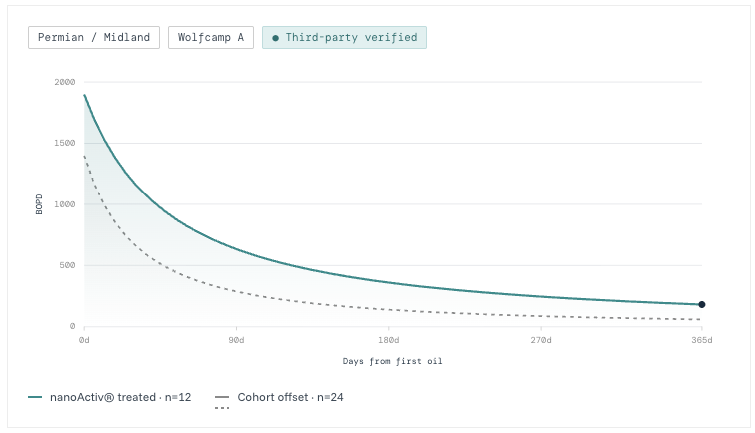
What changes on the curve.
The uplift is persistent. Treated wells produce higher for longer relative to offset baselines through both early-time and late-time production behavior. The shape of the decline doesn’t change. The recovered EUR does.
This is the difference between incremental chemistry and reservoir response.
INTEGRATION
The operator’s completion design doesn’t change. nanoActiv® doses inline into the existing fluid system.
06
Verified uplift report
Operators submit target pad inventory for screening and treatment review.
WHAT NANOACTIV® DOES
Not a chemical additive. A performance asset.
nanoActiv® is a nanoscale, engineered nanoparticles dispersion. It transports through pore networks no surfactant micelle can reach, alters rock-fluid interaction in place, and helps mobilize hydrocarbons already at risk downhole.
WHAT THE OPERATOR PROVIDES
01
Candidate pads + offset data
Production history and offset-well information for comparative analysis.
02
Completion design
Fluid systems, sand program, stage spacing, and compatibility details.
03
Fluid sample
Water chemistry, biocide, scale inhibitor, and base-water information.
WHAT THE OPERATOR RECEIVES
01
Candidate model
Offset-normalized uplift projections with basin analog comparisons.
02
Treatment design
Formation-specific treatment program with execution plan.
03
Field execution
Inline treatment support and real-time operational oversight.
04
Lift data + field cohort view
Operator-specific production comparison with cohort analysis and post-treatment evaluation.