TECHNOLOGY • HOW IT WORKS
The mechanism, end to end.
The mechanism, end to end.
What happens when nanoActiv® enters the wellbore. We walk through it in four steps: particle transport, surface interaction, wettability shift, and incremental hydrocarbon mobilization.
MECHANISM • STEP BY STEP
Four sequential effects, one downhole outcome.
No magic. Each step is a known physical effect at nano scale. Together they produce the recovery uplift Act measures with third-party data.
01
Particle transport via Brownian motion
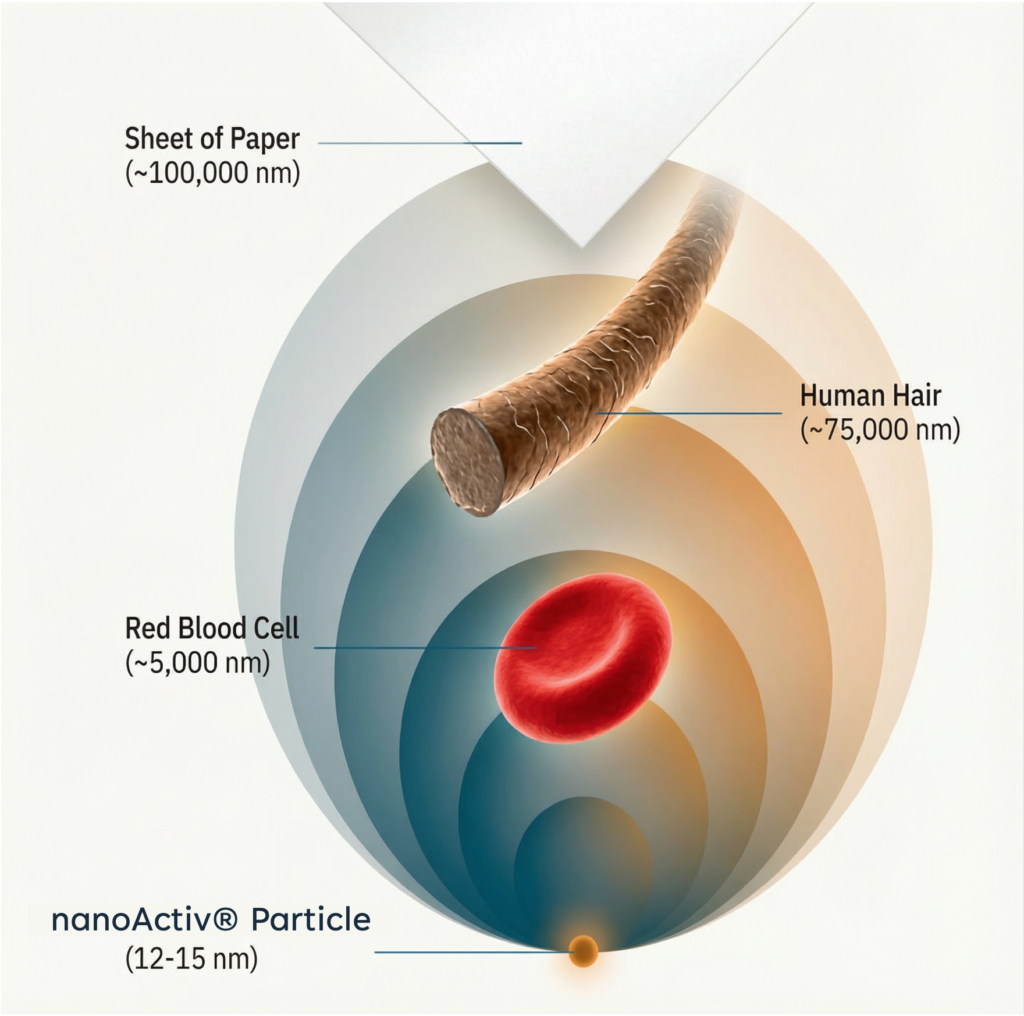
At 12–15 nm, nanoActiv® particles do not settle in pore-network water. Brownian motion and diffusion drive them through pore throats that surfactant micelles* (2–5 μm) physically cannot enter. The pore-network reach is the foundation of the mechanism.
TECHNICAL NOTE
Particle diffusivity ~10⁻⁹ m²/s, orders of magnitude higher than micelle systems.
02
Wedge film formation at the rock-oil contact
Once a particle population reaches the three-phase contact line where oil meets rock and water, the particles self-assemble into an ordered wedge-shaped film. This film exerts a structural disjoining pressure that pushes hydrocarbons away from the rock surface.
TECHNICAL NOTE
Disjoining pressure mechanism per Wasan & Nikolov, Nature Vol. 423, 2003.
03
Wettability shift toward water-wet
As the wedge film lifts the bound hydrocarbon off the rock, water replaces oil against the rock surface. The contact angle (oil/water/rock) shifts from >90° (oil-wet) toward <90° (water-wet), changing the relative permeability of the connected pore network in favor of oil flow.
TECHNICAL NOTE
Contact angle shift documented in core-scale lab measurements.
04
Hydrocarbon mobilization to wellbore
Pressure drawdown during production now draws more of the previously-bound oil into the connected pore network and toward the wellbore.
TECHNICAL NOTE
Measured uplift typically established by 180 days; firm by 1 year.
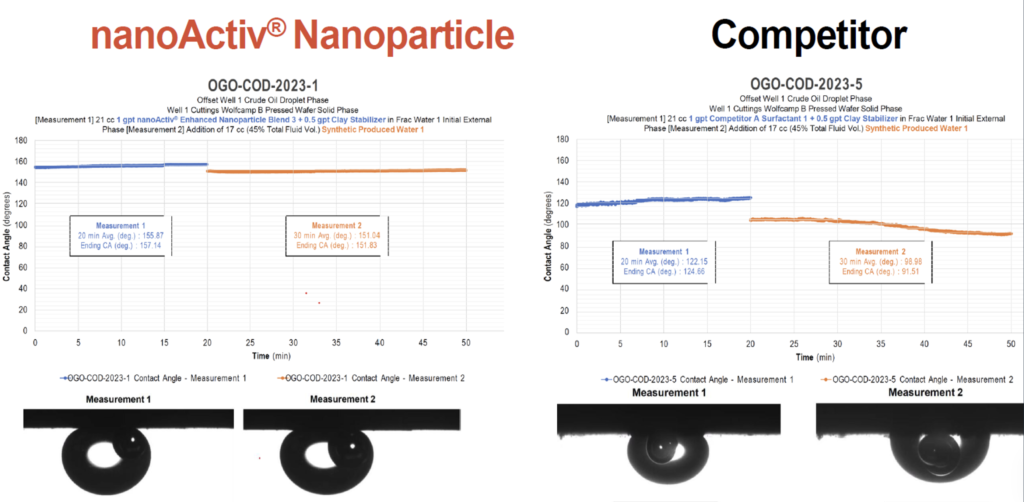
nanoActiv® anchors to the rock surface and resists wash-off. Competitor surfactant rinses away, surrendering wettability gains.
After Washing:
– nanoActiv® treated: Oil-Wet, helds at 155°
– Competitor Surfactant: Reverts back down to 91°, more towards water-wet.
DIFFERENTIATION
Why this is not a surfactant approach.
Surfactant-based oilfield chemistry has been tested extensively. nanoActiv® is in a separate physical regime.
| Dimension | nanoActiv® | Surfactant chemistry |
|---|---|---|
| Active size | 12–15 nm particles | 2–5 μm micelles |
| Pore-throat access | Transports through | Limited by micelle size |
| Mechanism | Wedge-film disjoining pressure | Interfacial tension reduction |
| Persistence | Sustained uplift: 30+ months verified, 45-well cohort | Variable by application |
| Reservoir distance | Throughout connected pore network | Near-wellbore |
Key physical properties
| Particle size (mean) | 12–15 nm |
| Particle composition | Surface-functionalized silica |
| Dispersion phase | Aqueous |
| Active concentration | New Completion: 0.5GPT - 1 GPT; Re-Stim / EOR : 5 GPT+ |
| pH range | 3-11 |
| Brine compatibility | TDS of up to 250,000 ppm |
| Thermal stability | ≤ 350°F |
| Density | ~1.05 g/mL |
| Storage | Sealed totes, ambient |
CONTENTS
Where nanoActiv® acts
nanoActiv® particles concentrate at the three-phase contact line where oil meets rock and water, where they self-assemble into an ordered wedge-shaped film. The structural disjoining pressure created by that film (Vasan & Nikolov, Nature Vol. 423, 2003) lifts the bound hydrocarbon off the rock surface and lets water move against the rock. The result: a wettability shift from oil-wet toward water-wet, oil freed to flow toward the wellbore, and a sustained effect from the residual particle population. Full mechanism walkthrough on the How It Works page.
Production impact
The shift doesn’t change how much oil is in place. It changes how much of that oil is recoverable through the existing wellbore at the existing drawdown. In practice, the response shows up in the first 30–60 days of post-treatment production and stabilizes by 90 days.
Lab and field support
Contact-angle measurement is the standard lab proof. Activ uses imbibition testing on representative core samples as a screening step before field deployment. Field proof is third-party-sourced 90-day cumulative production analysis against cohort offset baseline.
The mechanism description above is operator-evaluation-grade. Detailed lab data packets, including representative core imbibition curves, are available under NDA on request.